

For decades, network cooking shows have dazzled audiences by combining reality TV drama with mouth-watering close ups of bubbling sauce and slowly caramelizing sugar, while scripted scenes of celebrity chefs chucking pans across the kitchen offer a colorful impression of kitchen life. But these extravaganzas don’t always reflect the realities of culinary competitions. Molds, staged dishes, heightened drama, touch ups, and editing software can distort the craft like a funhouse mirror. And though not all television is fake, the smoke and mirrors used by production crews can sometimes leave us guessing what’s real and what’s not.
While you can’t always trust what you see on TV or scrolling through Instagram, the drama and excitement of the Coupe du Monde de la Pâtisserie is 100% organic. The action, the technique, the fanfare, all unfold in real time in front of a live audience.
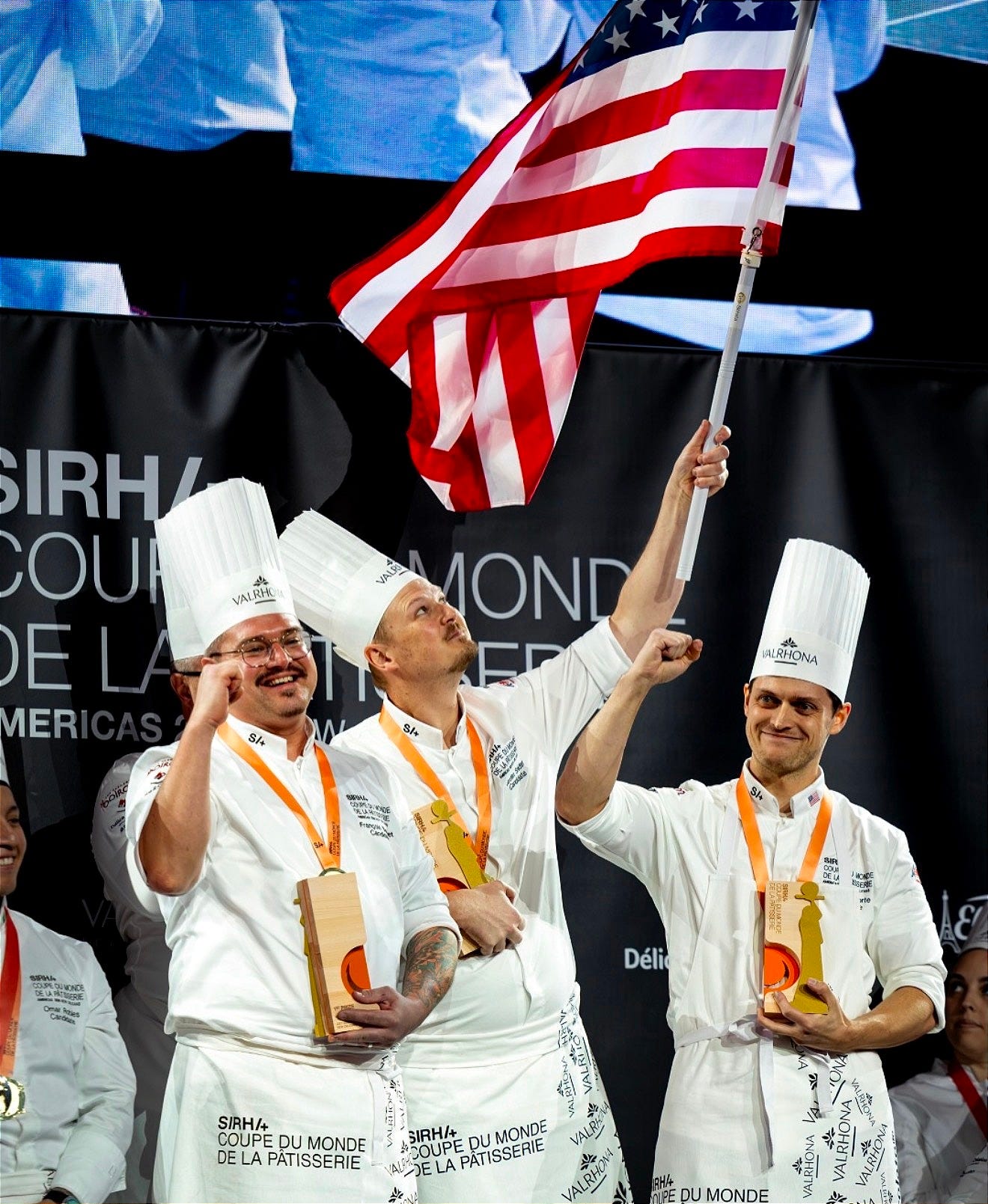
At the Coupe du Monde nothing is staged, nothing is dramatized. There are no fast cuts or cinematic edits. Every piece is prepared in a nine hour window under strict supervision in front of an international audience. And if using a blow torch to craft a 3D dinosaur made entirely out of sugar while excited fans shout and bang drums wasn’t hard enough, competitors are also judged on the finer points of their performance. Meticulous details like cleanliness, efficiency, and professionalism can make or break a team’s score. Which is why Team USA has spent years training for their shot at a world title.
The Road to a World Title
Every month, the team meets in Chicago to practice for the big day. And while there may only be three chefs competing, the club consists of more than a dozen team members—including coaches, accountants, logistics managers, and more. And that list doesn’t even include the dozens of sponsors who support Team USA through their generous donations, which help cover expenses ranging from ingredients and cookware to transportation and lodging.
In preparation, the team works closely with artists to create blueprints for their sculptures and dishes. Then, once the details have been finalized, they hit the kitchen to work out how to prep each piece efficiently and within the allotted timeframe. Practice sessions also provide an opportunity to troubleshoot potential hazards.
According to Team USA Club President Stephane Cheramy, the biggest game day challenge isn’t cooking but temperature control. At the start of the day, the room is chilled. But as the crowd fills in, the temperature begins its rapid ascent from cool and dry to muggier than the Florida Everglades. In this environment, the warm breath of screaming fans is enough to fog glass halfway across the room—which makes it hard for teams to keep their elegantly chiseled ice swans from melting into droopy ducklings.
What is the Coupe du Monde?
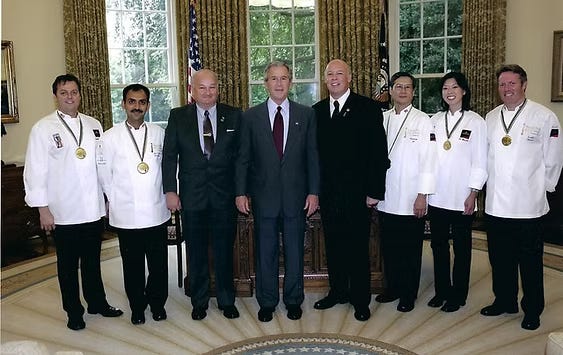
Dubbed the “Pastry World Cup,” the Coupe du Monde is the world’s premier pastry competition, and the prestige of a gold medal win is enough to turn the heads of world leaders. In 2001, the US won their first gold medal—earning the team a trip to the White House and a congratulatory handshake with then president George W. Bush.
Created by Master Chef Gabriel Paillasson in 1989, the competition serves as a platform for teams to showcase their talent and heritage for the whole world to see. But so much more than just a pastry exhibition. The Coupe du Monde exists to push the industry to new heights through criteria that promote innovations in creativity and sustainability.
Crème de la Crème: National Selection


Before competing in New Orleans for a shot at the world title, chefs Jordan Snider, François Behuet, and Nicholas Forte had to first prove themselves in what Club President Stephane Cheramy has called “The Superbowl of Pastries.”
Held every two years, top pastry chefs from across the country gathered in Chicago to compete for the chance to represent the US at the Coupe du Monde.
In celebration of the America’s upcoming 250th anniversary, “national heritage” was chosen as the theme for the 2025 selection competition. Competitors were asked to prepare six identical desserts featuring at least 60% Valrhona chocolate, highlighting two textures and two temperatures. (Side note: Valrhona became the first chocolate truffle in lunar orbit this year when astronauts of Artemis II brought a bag of Astreas—crafted with Valrhona chocolate—on their moon mission.)
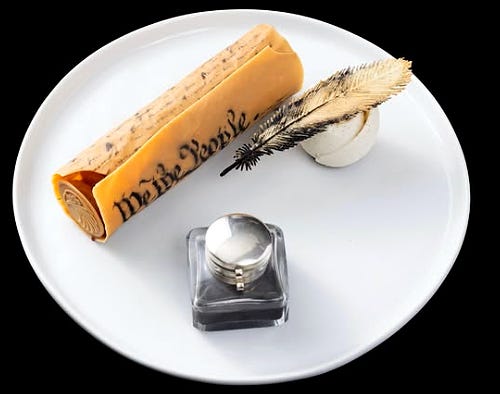
One highlight was Nicholas Forte’s “Ink & Quill”—featuring a rolled piece of yellowed paper titled “We the People” written in black cocoa butter spray, representing the Declaration of Independence. Accompanying it was a feather tuile dipped in black “ink” resting atop a carefully crafted swirl of smoked vanilla ice cream.
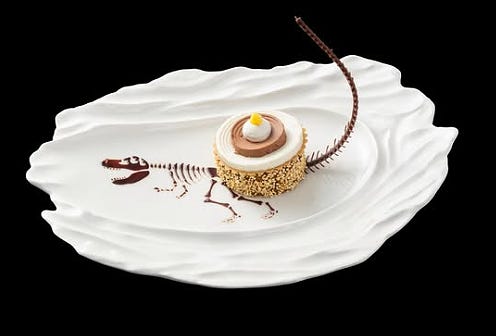
Equally impressive was one of Francois Behuet’s desserts, which consisted of a confection made of banana ice cream, pineapple compote, white chocolate mousse, dark chocolate mousse, and banana sponge atop a chocolate drawing of a dino skeleton—foreshadowing the team’s gold medal-winning display in New Orleans. Sticking out of the confection, a skeleton tail tuile blurs the border between dimensions, creating the impression of bones leaping off the plate.
Unsurprisingly, Forte and Behuet were awarded spots as the team’s ice sculptor and chocolatier. The position of team captain and resident sugar expert was given to none other than Jordan Snider—executive pastry chef of The Sanctuary at Kiawah Island, a Forbes triple 5-star resort.
Collectively the team has worked in more than half a dozen Forbes and Michelin-starred establishments, including the Fairmont Grand Del Mar, Pendry West Hollywood, The Ritz-Carlton in LA, The Cosmopolitan of Las Vegas, The Greenbrier Resort, Mandalay Bay, MGM Grand, and more.
Can You Dig It?


Growing up, your parents probably told you not to play with your food. But thankfully for the competitive chefs of Team USA this is one lesson that didn’t stick.
As a requirement for the Coupe du Monde de la Pâtisserie Americas Selection in New Orleans, Team USA was tasked with creating an immersive experience that combined gourmet cooking with street food style entertainment. America’s top pastry chefs responded to this colossal challenge by crafting a prehistoric dig site complete with dusters, magnifying glasses, and head lamps. By turning their dessert into an archaeological adventure, they invited judges to uncover the flavors of their creation by digging through sumptuous layers of caramel and chocolate to discover the ingredients buried beneath.
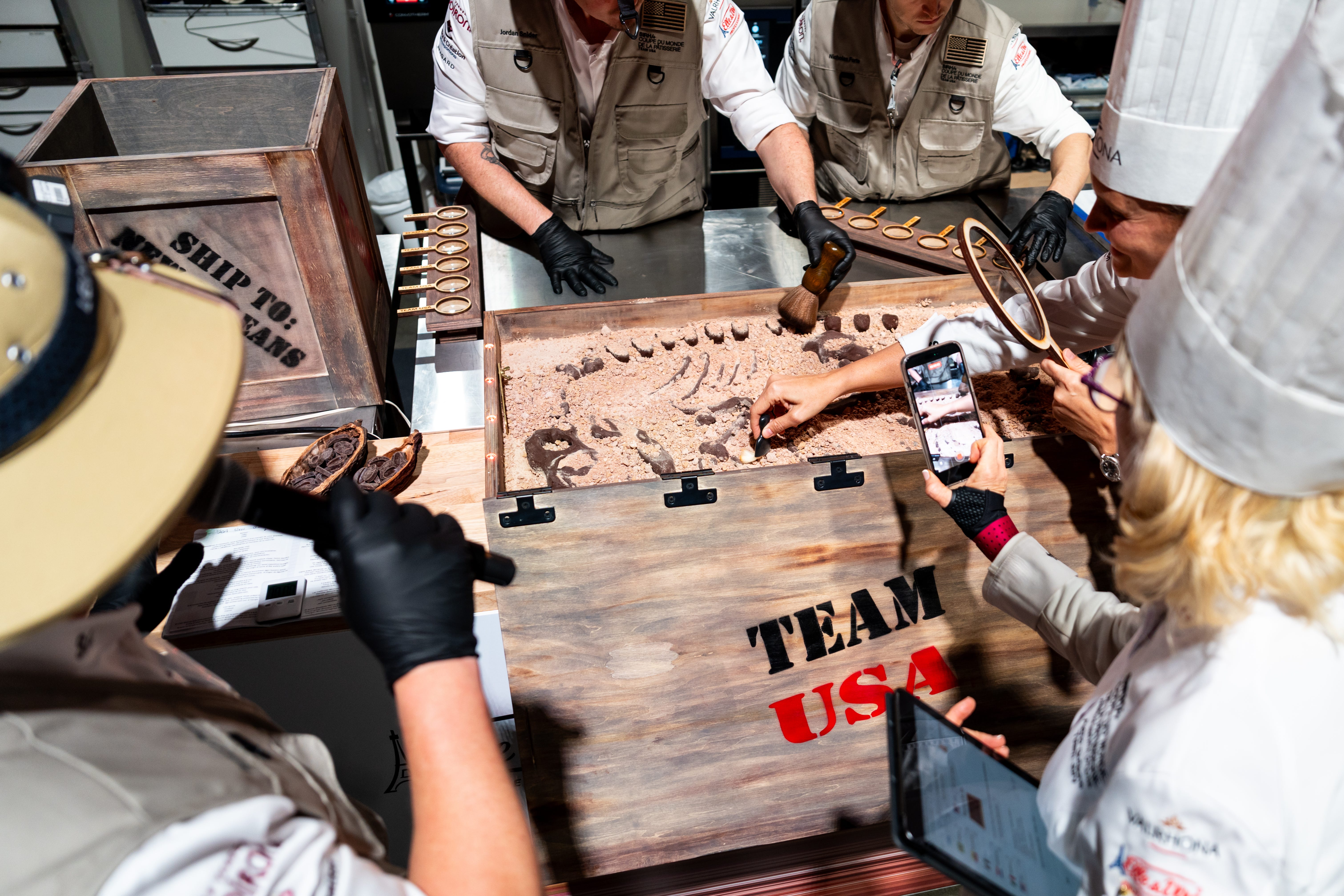
At the heart of their presentation was a mysterious wooden crate labeled “EXCAVATION No. 725.” As the judges gathered round, the chefs opened the crate, revealing the chocolate skeleton of a tyrannosaurus rex buried beneath a dusting of crystallized chocolate crumble. At the center of the display lay an assortment of chocolate vertebrae, each handcrafted and featuring ingredients imported from around the world. Salted caramel, espresso chantilly, cocoa sable, Dominican chocolate mousse, and quinoa crunch were stacked like layers of sediment and encased in a dark chocolate shell.


Similar to competitive cooking, archaeological excavations require an extraordinary amount of patience and a keen eye for detail, making it an apt analogy for everything Team USA had to go through for a shot at a world title. In preparation for the competition, hundreds of hours were spent sculpting chocolate, pulling sugar, carving ice, failing, rebuilding, adjusting, and starting over again.
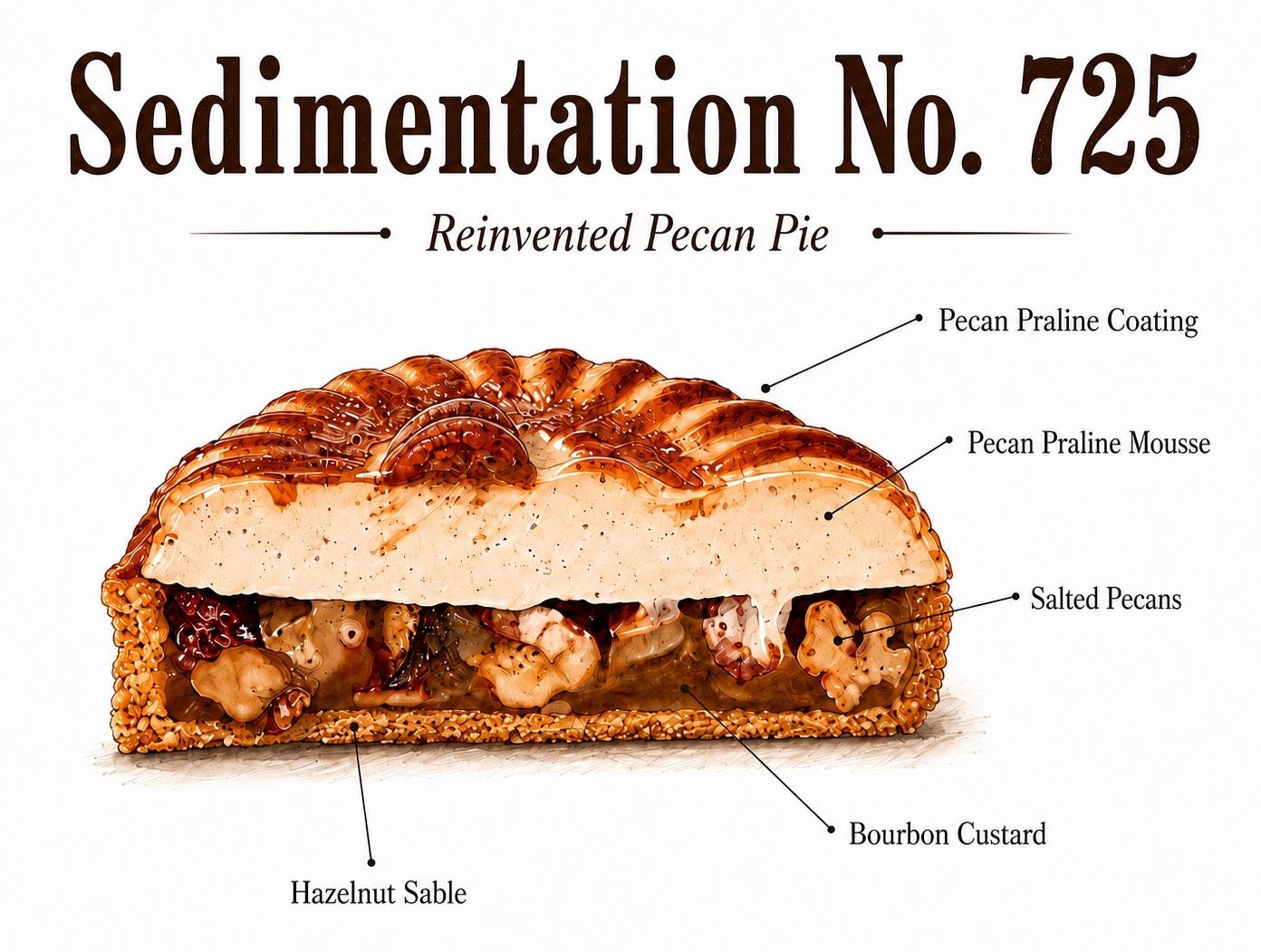
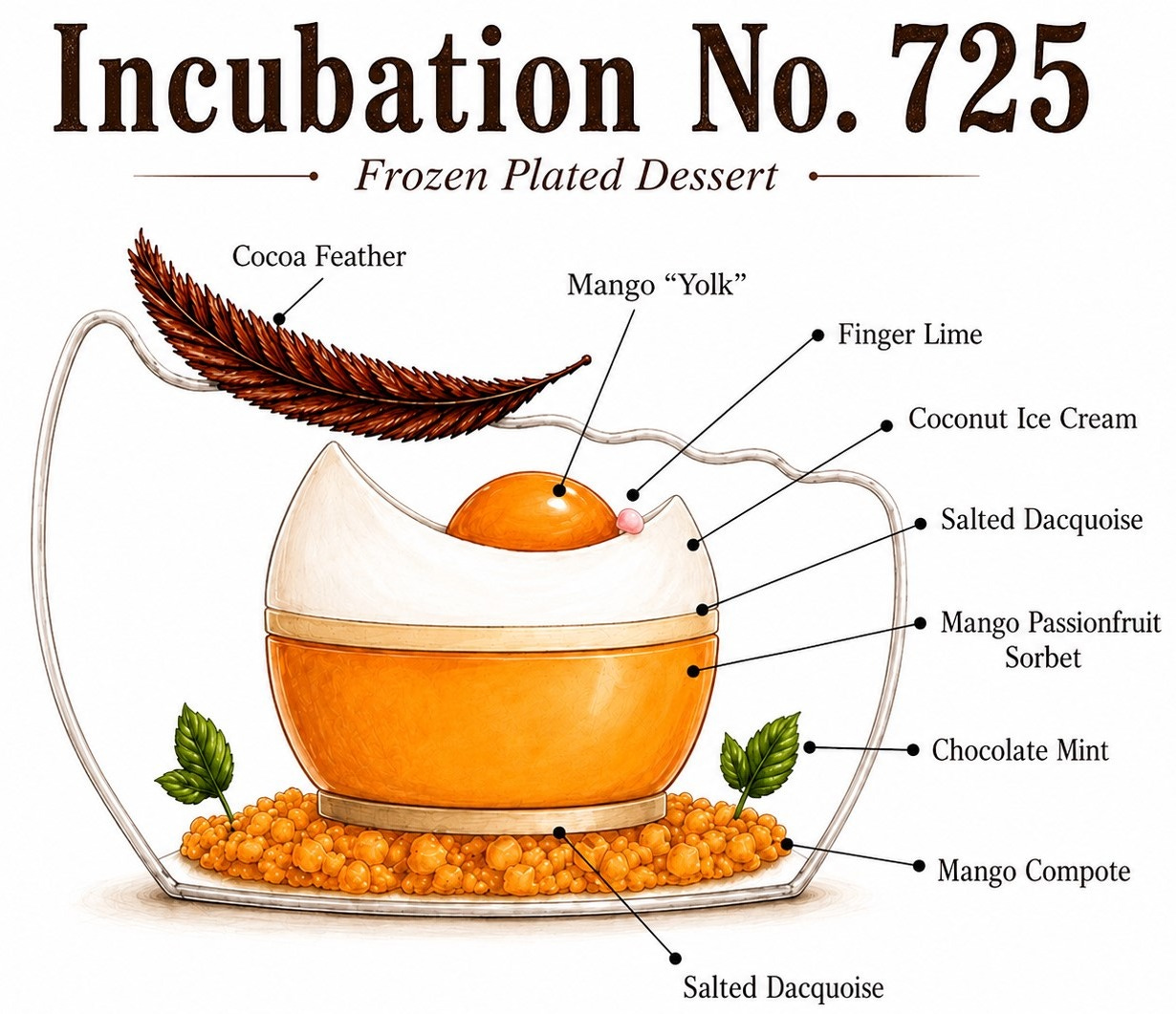
Shockingly, this jaw-dropping display was only part of the overall competition. In addition to their dig site, Team USA was also required to create both baked and frozen desserts. Keeping with their theme—Jurassic Relics—they crafted a fossilized pecan pie inspired by an ammonite shell, titled “Sedimentation,” and a dino eggshell featuring mango sorbet, called “Incubation.”
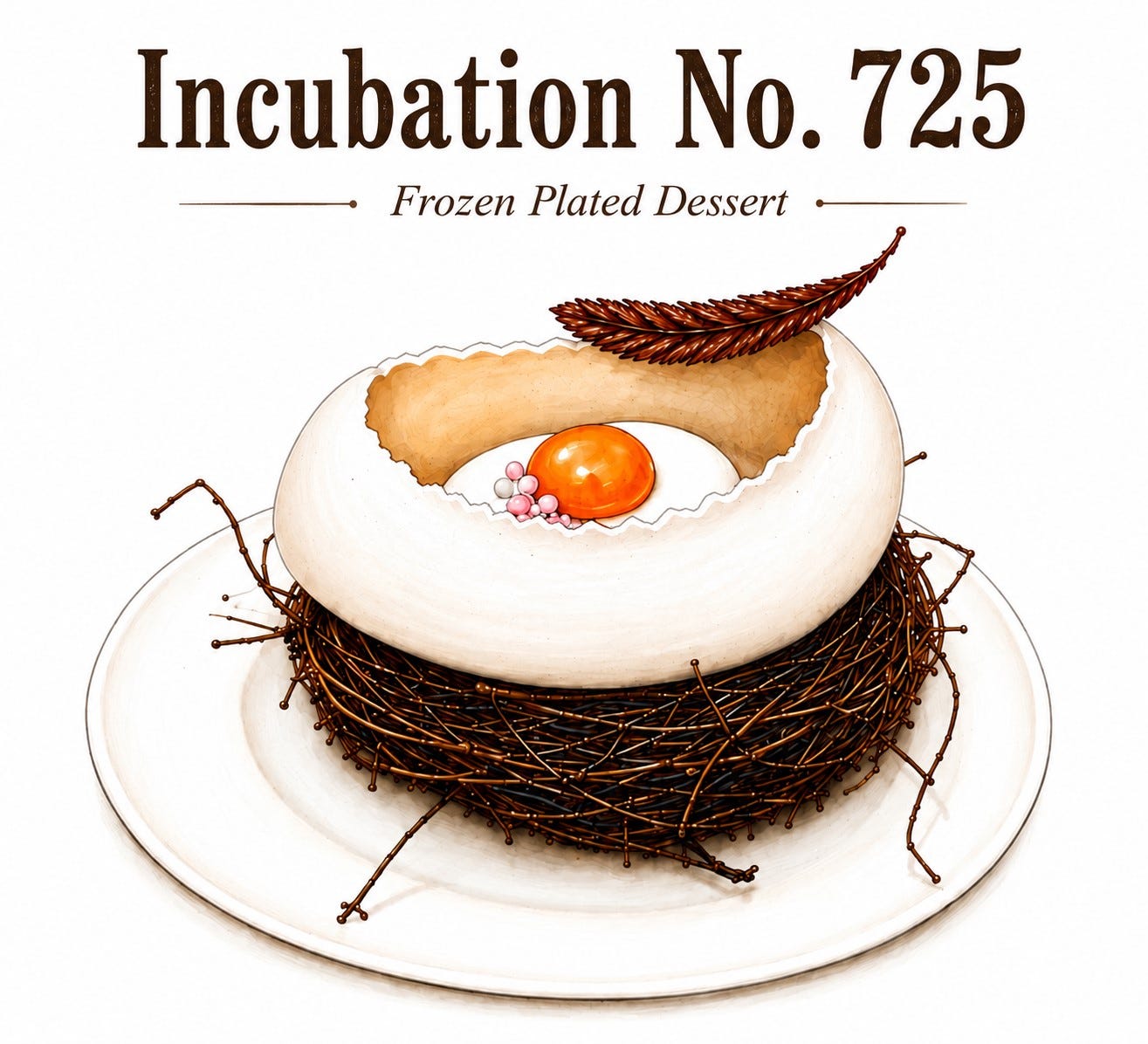
Sedimentation featured hazelnut crust with a salted pecan and bourbon custard filling beneath a shell-shaped pecan praline mousse, with a side of maple ice cream. Incubation used mango sorbet for the yolk and coconut ice cream as a stand-in for egg white with layers of mango compote and salted dacquoise beneath, rounded off by mint and a delicately placed cocoa feather.
And oh yeah, and did we mention that on top of everything else they also had to create three artistic sculptures made from sugar, chocolate, and ice—in five and a half hours?!


Preparing for the World Cup
After taking home gold in New Orleans, Team USA has secured their place at the Pastry World Cup in Lyon, France—where they’ll compete head to head with the greatest pastry chefs of their generation for a world title.
Team USA is only one of eight nations to have won gold at the Coupe du Monde. But unlike other international heavyweights, they lack the astronomical budget of teams like Italy and France.
The cost of a world title is steep, and it takes a lot more than raw talent to bring home gold. Airfare, training facilities, coaching, uniforms, marketing, and ingredients all factor into the equation. Which is why sponsorships are so essential to international success.
Chef Cheramy’s Recipe for Success
To manage all these moving pieces, the club selected Stephane Cheramy to serve as president. After twenty years as executive pastry chef for Ritz-Carlton, Cheramy knows a thing or two about leadership—which is why he was the obvious choice to oversee selection, strategy, and preparation for the Coupe du Monde.
In addition to cooking in elite kitchens at luxury hotels like Le Cirque, Bellagio, and Ritz-Carlton, Chef Cheramy also spent years competing on the national and world stage. He won gold at America’s National Plated Desserts Competition and silver at the National Chocolate Competition in France. And although he is not easily swayed by emotion, Stephane Cheramy can clearly remember crying as he took his place on the podium to the sound of the national anthem playing in the background—cementing his lifelong love for competition.
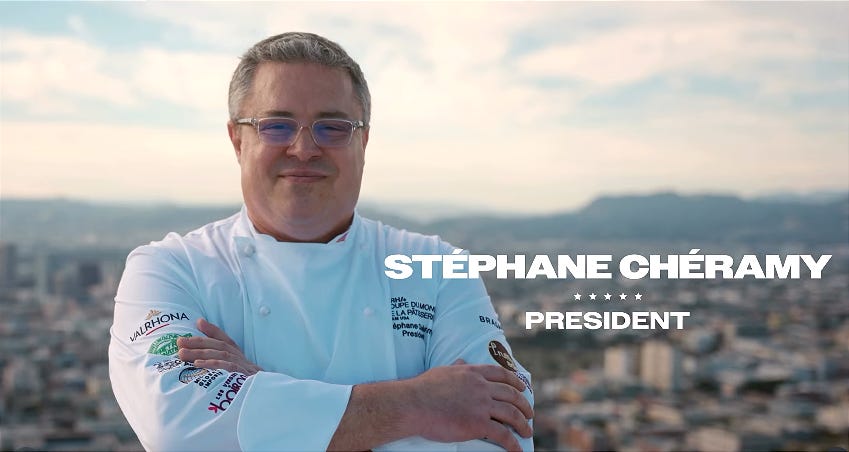
In preparation for the big day, Chef Cheramy has spent endless hours on the phone and digging through his inbox to secure the sponsorships needed to win a world title. To ensure his team is positioned for success, he has to make sure they have only the best—the freshest ingredients, the finest chocolate, the highest quality chef jackets. Premium brands like Valrhona and Bragard ensure that Team USA has what they need to compete with nations like Japan and France when they take the world stage next year.
Chef Cheramy’s favorite part about working with sponsors is that they don’t ask for anything, they just want to support the team. That sense of community and shared purpose is what makes the club so special. Being the leader of Team USA is about more than winning. As president, Cheramy supports the club’s mission of elevating the American culinary scene in the eyes of the world, while also inspiring chefs back home to push their craft even further through creativity and innovation.
Despite an unfathomable workload, Stephane Cheramy doesn’t get paid for his work with Team USA. He does it out of love for his adoptive country, his passion for pastries, and a lifelong ambition to push himself to become the best chef possible.
Looking Ahead
In January, 2027 the team will head to Lyon, France for the final showdown after two years of preparation. To win, the US will not only have to dethrone the reigning champions, Japan, but also defeat France, who has more gold medals than any other country and enjoys a home field advantage.
They’ll also be competing against Mexico, Paraguay, and Argentina, who they already beat in New Orleans. Other teams who qualified include the UK, the Netherlands, Belgium, Italy, South Korea, Malaysia, the Philippines, and Singapore. The Africa and Middle East qualifiers take place September 26 and October 1.
For up to date announcements on all things Team USA, make sure to follow them on Instagram!
Dressing the Part
Look good, feel good, cook good.


The official chef jacket of Pastry Team USA is available exclusively through Bragard. The best performing chef jacket on the market today, the team trusts Power when the pressure’s on.